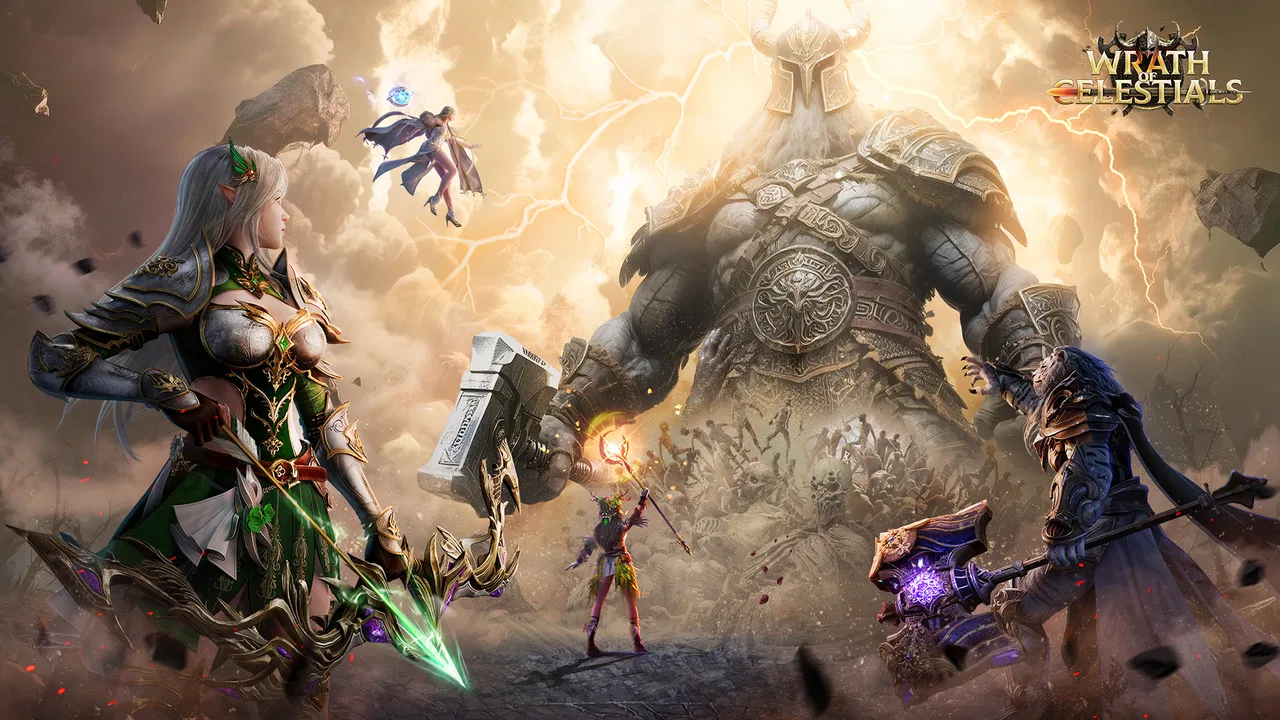
Wrath of Celestials
- 4.7
- Rating
- 500.00K
- Installs
- Free
- Price

 Analysis by App-foxy
Wrath of Celestials is a free role-playing game from Leniu Technology Co., Limited that immediately caught my attention with its dramatic promise of standing against a heavenly threat. I spent time looking at it as more than a quick fantasy download: I wanted to understand what kind of player it suits, how much pressure its free-to-play structure might create, and whether its presentation gives enough reason to keep returning.
The game is aimed at a broad audience, with an Everyone age rating, and it runs on Android 8.0 or later. Its current version is 1.4, so it feels like a title that has already moved beyond its earliest release stage while still being relatively new. The store page lists a 4.7 average from around 46 thousand ratings, with more than 500 thousand installs. Those figures suggest that plenty of players have tried it, although they do not tell me whether the experience stays equally satisfying after the opening hours.
My overall impression is cautiously positive. The celestial-conflict theme gives the game a clear identity, and the role-playing format should appeal to people who enjoy building a character or party over time. However, I would not recommend installing it blindly if you dislike free games that may place attention on purchases. It is free to start, but the presence of in-app purchases means the way you manage progress matters just as much as the battles themselves.
You May Also Like

 Blood Strike: 2.5 Anniversary
Blood Strike’s Loadouts Turn Every Drop Into a Tactical Gamble
A close look at Blood Strike’s custom loadouts: how fast access to signature weapons reshapes its battle royale rhythm, rewards preparation, and narrows the gap between fights.

 Pandora - Music & Podcasts
Pandora’s Music Is Easy to Start, but Harder to Recover
Pandora’s strength is its low-effort path from a seed to a station. Its weak spot is how much confidence it asks you to place in connection, setup, and quiet recovery.

 8 Ball Pool
 Is Built on Rivalries, Rematches, and Routine
A close look at the rivalries, rematches, shared routines, and unanswered safety questions that turn a quick pool match into a persistent mobile community.

 Samsung Music
’s Quiet Strength Is Playing What You Already Own
Its reach comes less from spectacle than from dependable access to a personal library. That simplicity is both the app’s strongest retention engine and its ceiling.

 AccuWeather: Weather Radar
AccuWeather Review: A Quick, Clear Forecast for Everyday Decisions
For everyday plans, the best forecast is the one you can understand quickly. AccuWeather makes rain timing, radar, and local conditions easy to act on, with a few trade-offs.

 Hill Climb Racing
Why Hill Climb Racing Still Turns Crashes Into One More Run
A tiny car, a bumpy hill and one more upgrade: Hill Climb Racing keeps resurfacing because its simple chaos makes every near-miss feel personal.
More From Our News Desk
View All News


How the celestial adventure feels in practice
I find the celestial-war premise most useful as a way to set expectations: this is a role-playing game to approach through steady progress, not a quick test of reflexes. In the sections that follow, I’d focus on how to make short sessions feel purposeful, then weigh the practical questions of reliability and device fit before deciding whether it belongs on your phone.
A focused fantasy premise rather than a casual time-killer
The strongest part of the concept is its sense of scale. “Defy Celestial's Wrath!” is not a quiet village adventure or a relaxed puzzle game; it frames the player as someone pushing back against an overwhelming supernatural force. That gives ordinary progress a useful emotional context. Improving a character, preparing for a difficult encounter, or returning after a short break feels connected to a larger struggle instead of being a disconnected sequence of menus.
I found that this kind of framing works best when I play in short, deliberate sessions. Rather than opening the game with no plan and tapping through everything, I prefer deciding what I am trying to improve first. A focused session might be about strengthening one part of my team, checking the next challenge, and then stopping before progress becomes routine. That approach helps a role-playing game feel less like a daily obligation.
Players who enjoy fantasy settings, gradual character development, and the satisfaction of becoming stronger over time will probably understand the appeal quickly. The game is also a reasonable choice for someone who wants a mobile RPG that can be sampled without paying at the start. On the other hand, people looking for a fully self-contained premium adventure should be cautious. A free-to-play role-playing game naturally asks for more patience and more attention to its progression rhythm than a paid game usually does.
What I would do during an everyday session
Imagine having a spare half hour after work or during a commute. I would begin by checking the current objective rather than immediately spending resources. Next, I would use the available progress to strengthen the weakest part of my setup, attempt the next meaningful challenge, and review what the result taught me. If the game offers several ways to advance, I would avoid scattering effort across everything at once and choose one improvement path for that session.
That habit is more important than it sounds. In a progression-focused RPG, small resources can appear plentiful at first and then become harder to replace. Spending everything simply because an upgrade is available can leave a player unable to respond to a tougher encounter later. I would keep a reserve until I understood the game’s rhythm, especially before making any purchase.
Another useful routine is separating genuine difficulty from an underdeveloped character. If I fail, I would not immediately assume that I need to pay. I would first check whether I missed an upgrade, used an inefficient combination, or attempted content before my character was ready. This simple pause is one of the best ways to keep a free RPG enjoyable rather than turning every setback into a spending decision.
Progression needs a patient approach
The role-playing format makes long-term improvement central to the experience. That can be rewarding because even modest gains feel meaningful when they help overcome a previously difficult obstacle. It can also become repetitive if the player is asked to repeat the same activities mainly to reach the next power threshold.
My advice is to treat progress as a series of decisions, not as a race. Keep track of which upgrade produces the clearest benefit, and avoid improving every available option equally. Concentrating resources usually gives a more noticeable result than spreading them thinly. This is especially useful for free players, who need to make their earned resources work harder.
The trade-off is that patience may be part of the intended experience. Someone who wants immediate access to every powerful option could find the pace frustrating. A player who enjoys planning, gradual growth, and returning to an earlier challenge with a better strategy is more likely to appreciate the structure.
Spending: what can be said with confidence
The game is free to download and lists in-app purchases at $1.49 per item. That gives the purchase system a clear entry point, but it does not by itself prove whether buying is necessary, advantageous, or merely convenient. I would not claim that the game is unfair simply because purchases exist, and I would not claim that it is generous without seeing how a completely free player progresses over a longer period.
For me, the safest approach is to play without spending until the basic loop makes sense. Learn what resources do, understand which improvements matter, and decide whether the game is enjoyable on its own. If the answer is yes, a small purchase can be considered as optional support rather than a rescue from frustration. If the answer is no, spending will not fix the underlying problem.
Parents should also remember that an Everyone rating describes the content audience, not the absence of purchase considerations. A child using the game on a shared device should have purchase controls managed beforehand. That is practical advice for any free mobile RPG, and it is particularly relevant here because the game offers paid items even though the initial download costs nothing.
Fairness depends on how progress is handled
Competitive fairness is the area where I would be most careful before making a strong judgment. The presence of $1.49 items tells me that spending is part of the product, but it does not reveal whether those items affect competition, speed up personal progress, provide convenience, or serve another purpose. Without that distinction, it would be wrong to label the game pay-to-win or to promise a perfectly level playing field.
My practical recommendation is to watch how the game treats a player who refuses to buy. If free progress remains understandable and failures can be solved through better choices or continued play, the purchase system may feel optional. If advancement repeatedly stops at points where payment appears to be the only sensible answer, the experience will feel less fair, even if the individual items are inexpensive.
I would also separate competition from personal progression. A player who mainly wants a solo fantasy journey may not care much if another person advances faster. Someone who values rankings, timed challenges, or direct contests will care deeply about whether paid advantages are involved. That second group should spend more time observing the game’s progression before investing money or treating its competitive results seriously.
Three habits that make the free route more comfortable
- Delay purchases until the progression loop is clear. The small price per item may look harmless, but repeated convenience purchases can change the total cost of a game session over time.
- Keep a resource reserve before difficult content. A reserve gives you room to respond after a failed attempt instead of forcing an immediate purchase or a long recovery period.
- Judge upgrades by impact, not by availability. The newest option is not automatically the best use of resources. Strengthening a weak point is often more valuable than adding another minor improvement.
These habits are not secret mechanics, but they are practical ways to protect the player’s time and budget. They also help reveal whether the game is genuinely enjoyable without artificial urgency. If I can make sensible progress while following them, I feel more comfortable recommending the experience to a friend.
Where the game may fall short
The main limitation is not a single flaw I can point to; it is the uncertainty that comes with a relatively new free-to-play RPG. A strong premise and a high average rating can encourage an install, but they do not guarantee that the long-term loop will remain varied. Role-playing games often feel most exciting at the beginning, when every improvement is noticeable. Later, the same systems can feel more demanding if the rewards slow down.
I would also avoid expecting the depth of a large console-style role-playing game. A mobile title built around quick sessions usually makes different compromises, whether in complexity, pacing, or the amount of exploration. That does not make it inferior, but it means the right expectations matter. Wrath of Celestials is better approached as an accessible mobile fantasy progression experience than as a replacement for a sprawling premium RPG.
Another point of friction is the need for self-control around purchases. Even when each item costs only $1.49, the decision can become less clear if it is repeated whenever progress feels slow. Players who prefer a fixed upfront price may find this model less comfortable than buying a complete game once. In that situation, a traditional paid RPG may be the better choice, even if it offers fewer ongoing updates or shorter replay value.
Who should install it, and who should skip it?
I would recommend giving the game a try if you enjoy fantasy conflict, gradual character improvement, and mobile sessions that can be shaped around your own pace. It is especially suitable for players who are comfortable starting free, learning the systems, and deciding later whether optional purchases add enough value. The Everyone rating also makes it approachable from a content perspective, although spending controls still deserve attention.
I would steer away from it if you want a premium experience with no purchase prompts, no resource management pressure, and a clearly finished campaign from the first launch. I would also be cautious if your enjoyment depends entirely on competitive equality, because the available information confirms purchases but does not establish how they interact with competition. In that case, observe the progression carefully before committing to rankings or spending.
Compared with the usual alternatives in the mobile role-playing category, this game’s most obvious advantage is its free starting point and direct celestial-war identity. A conventional paid RPG is likely to offer a more predictable cost, while a purely casual game will usually demand less attention from the player. Wrath of Celestials sits between those choices: it offers a fantasy progression journey without an entry fee, but asks the player to manage time, resources, and spending decisions.
My trust verdict after weighing the trade-offs
The developer, Leniu Technology Co., Limited, presents a game with a clear theme, a broad age rating, and a free entry model. Its current version is 1.4, and the response from players looks encouraging based on the 4.7 average and the large number of ratings. I see enough here to justify trying it, particularly for someone who already enjoys role-playing games on a phone.
My recommendation comes with a boundary: start as a free player and treat every purchase as optional until the game proves that it respects your time. Do not buy simply because a failed attempt feels uncomfortable. Use the failure to identify what needs improvement, preserve resources, and see whether normal play can solve the problem. That test will tell you more about the game’s fairness than its store summary can.
In the end, Wrath of Celestials is most convincing as a patient, free-to-start fantasy RPG rather than as a guaranteed blockbuster or a substitute for every other role-playing game. I like its focused celestial premise and the possibility of building progress over repeated sessions. I would recommend it to a friend who enjoys that kind of gradual challenge, while being honest that players who dislike in-app purchases or demand fully transparent competitive balance may be happier elsewhere.
FAQs for Wrath of Celestials
01What is the main objective of Wrath of Celestials?
Wrath of Celestials is an action-packed RPG where players delve into a richly crafted fantasy world. The main objective is to complete quests, defeat powerful enemies, and collect legendary loot while uncovering the mysteries of the Celestial realm. Players must strategize and enhance their skills to progress through the game.
02Is Wrath of Celestials free to play?
Yes, Wrath of Celestials is free to play, offering a wide range of content without any initial cost. However, it includes in-app purchases that allow players to buy items, skins, and power-ups that can enhance gameplay. These purchases are optional and not required to enjoy the full experience.
03What platforms is Wrath of Celestials available on?
Wrath of Celestials is available on both Android and iOS platforms. It is optimized for mobile devices to ensure smooth gameplay and stunning graphics. Players can download the game via the Google Play Store for Android devices and the Apple App Store for iOS devices.
04Does Wrath of Celestials require an internet connection?
Yes, an internet connection is required to play Wrath of Celestials. The game features online multiplayer modes and regularly updated content that requires connectivity. Additionally, staying online ensures players can access the latest patches and participate in live events and community activities.
05How does progression work in Wrath of Celestials?
Progression in Wrath of Celestials is achieved by completing missions, engaging in battles, and upgrading characters. Players earn experience points and rewards that help unlock new abilities and equipment. A robust leveling system allows players to customize their characters to fit their preferred playstyle, ensuring a unique adventure for each player.
Pros
- Engaging storyline with rich lore.
- Impressive graphics and animations.
- Smooth and responsive controls.
- Diverse character customization options.
- Frequent updates with new content.
Cons
- Requires a stable internet connection.
- In-app purchases can be pricey.
- Occasional ads interrupt gameplay.
- Limited offline features.
- High battery consumption.

Wrath of Celestials
Gallery